 Aashir Khalil
Official identity documents represent the primary point of contact between government administration and the citizen. However, when strict executive regulations fail to accommodate inherent constitutional rights, administrative procedures turn into an instrument of exclusion.
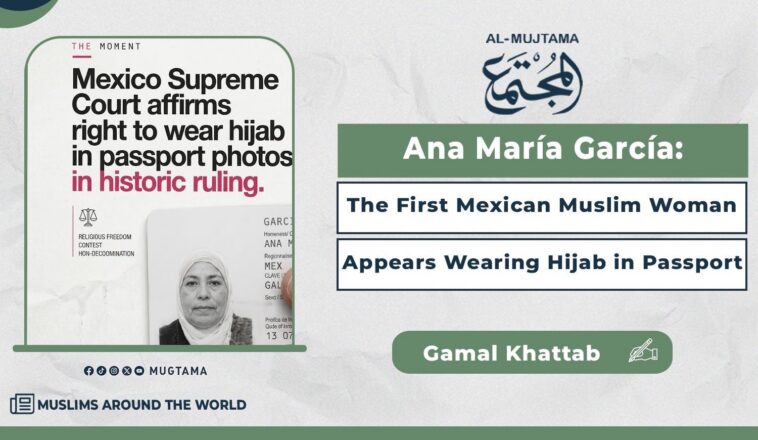
The story of Ana María García Laguna—the first Muslim woman in Mexico’s history to legally obtain an official passport featuring her photo while wearing the hijab—constitutes a constitutional and historical precedent for freedom of belief, women’s rights, and administrative equality in Latin America, as reported by the Al Mujtama Magazine.
Muslims in Mexico: Numbers, Origins, and Religious Freedom
According to statistics from the National Institute of Statistics and Geography in Mexico (INEGI), the Muslim population is estimated at approximately 7,900 to 10,000 people, representing less than 0.01% of the total population.
The Muslim community in Mexico is distinguished by its demographic diversity:
- Origins: The community includes descendants of Middle Eastern immigrants (specifically from Lebanon, Syria, and Palestine who arrived in the late 19th and early 20th centuries), along with a growing number of native Mexican converts to Islam in Mexico, particularly in major cities such as Mexico City, Guadalajara, and Puebla, as well as indigenous Maya communities in the state of Chiapas.
- Activities: Mexican Muslims are active in cultural, educational, and charitable initiatives, establishing Islamic centers, soup kitchens, and interfaith dialogue institutions such as the Mexican Islamic Council.
- Freedom of Belief: The Mexican Constitution guarantees religious freedom under Article 24 of the Constitution of Mexico. Although minorities practice their rituals without direct state interference, the level of societal awareness regarding Muslim rights remains limited.
Percentage of Women and Official and Societal Pressures
Women constitute a significant proportion of Muslims in Mexico, largely due to many female Mexican citizens embracing Islam.
Because many of them do not come from traditional Arab or Islamic families, their decision to wear the hijab in Mexico is frequently met with societal questions and multiple pressures.
Mexican Muslim women face two types of pressure:
- Societal Pressures: Stemming from misconceptions that link the hijab to external imposition or female oppression, rather than viewing it as a free choice of faith.
- Official Pressures: Manifesting in outdated administrative rules drafted without consideration for religious attire, placing women in a forced choice between adhering to their identity or exercising their civil rights.
The Case of Ana María García: The Dispute and Legal Triumph
In 2023, Ana María García applied for a Mexican passport from the Ministry of Foreign Affairs to visit her family abroad. However, officials rejected the application based on Article 14 of the Passport Regulations, which required the head to be completely uncovered in official photos.
García refused to relinquish her hijab to exercise her natural right to travel and initiated a legal pathway through an amparo lawsuit (constitutional protection claim).
Supported by the Federal Public Defender’s Office, attorney Laura Etzel Pizarro, the Mexican Islamic Council, and the “Hijab Movement,” the lawsuit exposed a clear administrative contradiction: the National Electoral Institute allows women to wear the hijab on voter ID cards, provided facial features remain visible.
The case reached the Supreme Court of Justice of the Nation under docket number Amparo 418/2025.
The Supreme Court ruled that an absolute prohibition of religious head coverings violates constitutional guarantees of freedom of belief, human dignity, and non-discrimination.
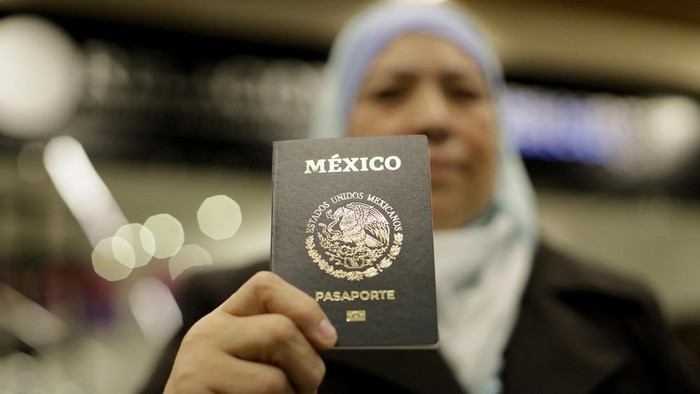
On July 13, 2026, Ana María García received her official passport wearing her hijab.
Other Beneficiaries and the Precedent of the “Hijab Movement”
Ana María García’s case paved the way for other Muslim women who had suffered from the same administrative obstruction. Most notably, Oma María Bel Lozano had previously lost an international job opportunity due to the refusal of her passport application with the hijab. Following the Supreme Court ruling, Lozano and other women were able to officially obtain their passports with the hijab.
The legal victory achieved by Ana María García Laguna is not merely a personal accomplishment resolving an administrative dispute between a citizen and a government institution; it embodies a pivotal turning point in the history of civil liberties and constitutional rights in Mexico and Latin America as a whole. This judicial precedent demonstrated that executive laws and regulations must be drafted as tools to integrate and protect all segments of society, rather than serve as a means to exclude them or restrict their constitutionally guaranteed religious practices.
This ruling issued by the Supreme Court of Justice redefines the relationship between national security requirements and identity verification on one hand, and respect for religious privacy and human dignity on the other. The judicial process proved that modern security measures—which rely on facial oval recognition technologies and biometric fingerprints—integrate flexibly with a Muslim woman’s appearance in her hijab without any conflict, dismissing the bureaucratic pretexts long faced by religious minorities.
The experience of Ana María García and the “Hijab Movement” embodied an inspiring message:
holding fast to faith identity and regarding the hijab as an act of worship and a free choice should never be a reason for deprivation from basic citizenship rights, such as the right to travel and work.
This historic victory has opened new horizons for Muslim women in Mexico, affirming that the strength and justice of a modern state are measured by its capacity to accommodate the cultural and religious diversity of all its citizens under the umbrella of the rule of law and social justice.